
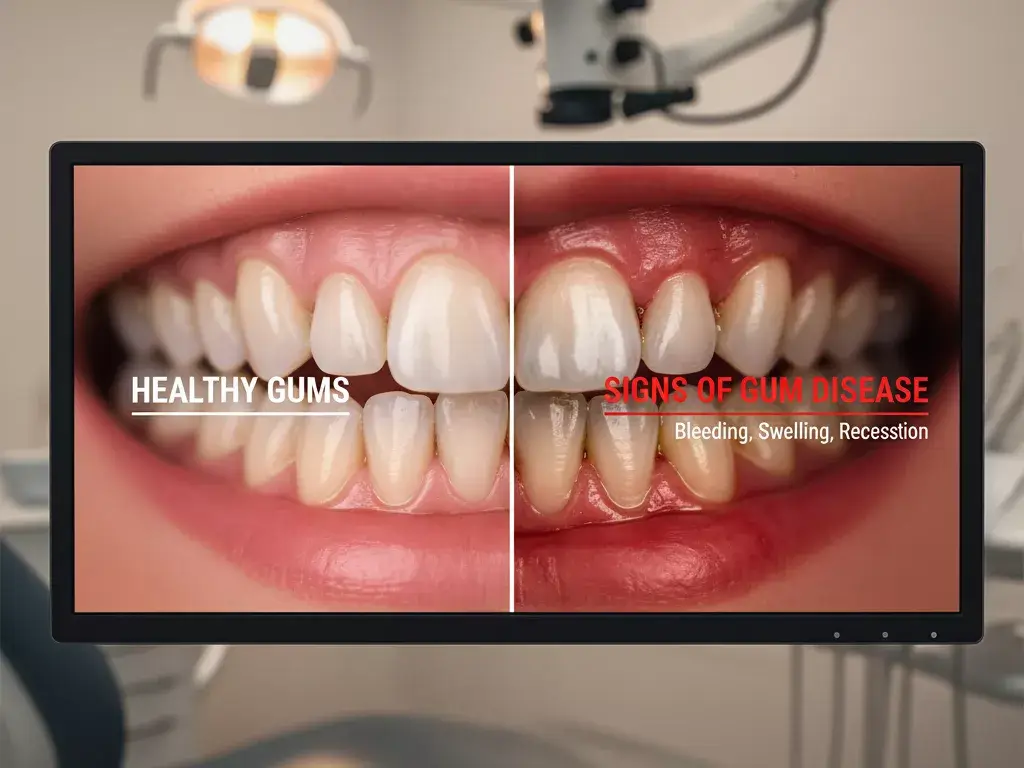
Quick Answer: The earliest signs of gum disease are bleeding when you brush or floss, gums that look like they’re “receding” (making teeth appear longer), persistent bad breath that mints don’t fix, tender or puffy gum tissue, and teeth that feel slightly different when you bite. These early signs of gum disease are easy to dismiss — and that’s the problem. Caught at the gingivitis stage, gum disease is fully reversible. Caught at the periodontitis stage, the bone loss is permanent. The difference between those two stages is often 12–18 months of ignoring the first signs of gum disease.
You rinse. You spit. A pink ribbon swirls down the drain and you barely notice it anymore. This has been happening for a while. Maybe years. You’ve told yourself it’s because you brush too hard, because you’re tired, because the dental floss is kind of rough. You’ve stopped mentioning it to your dentist because the last one said “you just need to floss more.”
Here’s what nobody told you: bleeding gums are one of the clearest signs of gum disease, and they’re not normal. Healthy gums don’t bleed. Not from brushing. Not from flossing. Not from a soft-bristled toothbrush used correctly. If your hands bled every time you washed them, you wouldn’t call that normal — you’d call your doctor. Your gums deserve the same urgency. That pink in the sink is your body’s earliest warning signal for a disease that, if ignored long enough, will take your teeth.
The good news: at the stage where you’re reading this article — where bleeding is the worst of it — the entire problem is still reversible. That window closes as the disease progresses. Here’s how to recognize where you are.
Understanding the Signs of Gum Disease: What’s Actually Happening Under Your Gumline

Gum disease is a bacterial infection, not a hygiene grade. Even people who brush and floss twice a day can develop it — though poor hygiene speeds it up dramatically. The infection starts in the plaque that builds up at the gumline, then progresses through predictable stages. Understanding the stages is the key to understanding why early signs of gum disease matter so much.
Stage 1: Gingivitis. Bacteria irritate the gum tissue. Gums become inflamed, red, and bleed easily. The bone under the tooth is still completely intact. This stage is fully reversible with professional cleaning and improved home care. Most adults have some degree of gingivitis at any given time.
Stage 2: Early periodontitis. The infection moves under the gumline. Small “pockets” form between the tooth and gum, trapping more bacteria. The body starts dissolving bone around the tooth as part of an immune response. This damage is not reversible — bone loss, once it happens, is permanent. But progression can be stopped.
Stage 3: Moderate periodontitis. Deeper pockets, more bone loss, gum recession becomes visible. Teeth may start to feel subtly different. Treatment requires scaling and root planing (deep cleaning), often with antibiotics.
Stage 4: Advanced periodontitis. Significant bone loss. Teeth may feel loose, shift position, or fall out. Treatment may require periodontal surgery, bone grafting, or extraction and replacement with implants.
The jump from Stage 1 to Stage 2 is where the real cost of delay lives. Everything before that line is fixable. Everything after leaves permanent damage, even if the disease is successfully halted.
Now — the five signs of gum disease that mean you’re standing at or near that line.
1. Bleeding When You Brush or Floss: The Most Dismissed of All Signs of Gum Disease
This is the one everyone explains away. It’s also the one that’s diagnostic almost by itself.
Healthy gum tissue is firm, pink, and doesn’t bleed under normal brushing or flossing pressure. When you see “pink in the sink,” it means the blood vessels in your gums have become fragile and leaky — a direct result of inflammation fighting off bacterial buildup at the gumline. That’s your body saying “there’s an active infection here.”
Common ways patients explain away one of the clearest signs of gum disease:
- “I just brushed too hard.” A soft-bristled brush used correctly shouldn’t cause bleeding. If yours does, it’s the gum, not the brush.
- “It’s because I flossed for the first time in a while.” This is the opposite of the truth. Healthy gums adapt to flossing within 2–3 days. Persistent bleeding after a week means something else is going on.
- “I’ve always had sensitive gums.” Usually not — this is learned dismissal after years of bleeding being treated as normal.
- “It stopped after a few days.” Gingivitis often quiets down when you temporarily brush harder, only to return. The infection hasn’t resolved; you’ve just disrupted the symptom.
If you see blood more than once or twice in a month, that’s worth flagging at your next cleaning — or booking one if you haven’t been in a while.
2. Receding Gums: One of the Visible Signs of Gum Disease You Can See in the Mirror
Pull out a photo from five or ten years ago. Compare it to the mirror today. If your teeth look noticeably longer now, your gums haven’t aged — they’ve receded.
Recession happens when gum tissue pulls away from the tooth and migrates upward, exposing more of the root. There are a few causes — aggressive brushing, bite forces, genetics — but one of the most common is gum disease. As bacteria destroy the soft tissue attachment, the gum line creeps back. That’s why recession is one of the most reliable visual signs of gum disease at the moderate stage.
Why this matters beyond appearance:
- The exposed root has no enamel. Enamel only covers the visible crown of the tooth. Below the gumline, the tooth is covered by a softer tissue called cementum, which decays roughly twice as fast. Root cavities are a different, more aggressive beast.
- Sudden cold sensitivity often starts here. If a tooth that used to feel normal suddenly reacts to ice water or cold air, exposed root is a common cause.
- Once gum tissue is gone, it’s gone. The body does not regrow lost gum tissue. Some cases can be addressed with gum grafts, but prevention beats repair every time.
A common progression we see: patient notices “a tooth looks longer.” Doesn’t mention it. A year later, that tooth has sensitivity. Two years later, it has a root cavity. All preventable if the recession had been investigated when it first showed up as one of the signs of gum disease worth flagging.
3. Persistent Bad Breath: The Subtle Among the Signs of Gum Disease
Bad breath from garlic or coffee resolves in an hour. Bad breath from morning dryness disappears after you brush. Bad breath that hangs around all day, doesn’t respond to mints or mouthwash, or comes back quickly after brushing — that’s something different.
The bacteria that live in infected gum pockets produce volatile sulfur compounds (VSCs) as they digest debris. These compounds smell distinctly unpleasant — sulfurous, sometimes faintly “meaty” — and they don’t come from food. Patients often tell us their partner mentioned it, or they’ve become self-conscious about speaking closely, or they’ve started relying on gum and mints all day.
Ways to tell if chronic bad breath is one of your signs of gum disease:
- It persists within 1–2 hours of brushing thoroughly, including the tongue
- A floss pick pulled between specific teeth smells distinctly bad after use
- Mouthwash only masks it for 20–30 minutes
- It’s worse in the morning and at the end of the day (when saliva production is lowest and pockets are most active)
- Your partner or family has gently mentioned it
This is not a failure of hygiene. It’s a sign the bacteria have colonized places your toothbrush can’t reach. Professional cleaning — often a deep cleaning — is what addresses it.
4. Tender, Puffy, or Discolored Gums: The Tactile Signs of Gum Disease
Healthy gum tissue is light pink, firm, and doesn’t hurt. Among the signs of gum disease that show up early, changes in gum appearance and texture are the most common — and the easiest to miss because they happen gradually.
Subtle indicators most people miss:
- Your gums feel “thick” or “swollen” around certain teeth — especially in the back of the mouth where you don’t look often
- A sharp sensation when food gets caught between specific teeth that didn’t used to feel anything
- Gums that feel tender when you press them with your tongue
- A slightly “spongy” texture instead of firm when you run your tongue along them
- Visible color change — the gum margin appears darker, more red, or slightly purple rather than the healthy pink
This is active inflammation. Your immune system is fighting an ongoing bacterial battle, and that’s what the redness and puffiness are. It’s treatable, but it’s not going to resolve on its own.
5. Shifting or Loose Teeth: The Latest-Stage Among the Signs of Gum Disease
This is the latest-stage sign on the list, and the one that tends to finally trigger a call. By the time teeth feel loose or shifted, the disease has been progressing for years and earlier signs of gum disease have been ignored.
Subtle versions of this sign that often go unreported:
- Your bite feels slightly different — teeth that used to line up now seem to meet differently
- A noticeable new gap between two teeth that used to touch
- A single tooth that feels like it “wiggles” slightly when you push against it with your tongue
- A front tooth that looks like it’s starting to angle outward compared to old photos
- Food traps in places it didn’t before — recurring food getting wedged in the same spot
Any of these is an urgent sign. The tooth’s foundation — the bone that anchors it — is being eroded by infection. At this stage, treatment shifts from cleaning to active intervention: scaling and root planing, possibly antibiotics placed directly into the pockets, sometimes surgery. The earlier you get in, the more of the tooth’s support structure can be saved.
Why the Signs of Gum Disease Matter Beyond Your Mouth
Gum disease isn’t just a dental problem — it’s a chronic inflammatory condition, and decades of research have linked it to other serious health issues. The strength of the evidence varies by condition, so here’s an honest read on why the signs of gum disease deserve real attention:
- Heart disease and stroke: Strong association. The bacteria found in dental plaque have been identified in the fatty plaques of clogged arteries. Causation is still being studied, but the American Heart Association acknowledges the connection.
- Diabetes: Well-established two-way relationship. Gum disease makes blood sugar harder to control, and poorly controlled blood sugar worsens gum disease.
- Pregnancy complications: Gum disease during pregnancy has been associated with increased risk of preterm birth and low birth weight.
- Respiratory infections: Bacteria from infected gums can be aspirated into the lungs, increasing the risk of pneumonia — especially in older adults and people with existing lung conditions.
- Cognitive decline: Emerging research suggests a possible link between chronic gum inflammation and Alzheimer’s disease, though this is still an active area of study.
Catching the signs of gum disease early is part of protecting your whole body. That’s not a sales pitch — it’s where the evidence points.
What Treatment Looks Like After Recognizing the Signs of Gum Disease
If you’re reading this thinking “I recognize several of these signs of gum disease,” the next step isn’t panic. It’s an exam.
At Aster Smiles, gum disease treatment is structured by stage:
- Gingivitis: A thorough cleaning to remove tartar at and slightly below the gumline, plus guidance on home care technique. Most patients see the bleeding stop within 2–3 weeks of consistent routine.
- Early-to-moderate periodontitis: Scaling and root planing (sometimes called a “deep cleaning”) — cleaning below the gumline to remove bacteria from the pockets, smoothing the root surfaces so tissue can reattach. Usually done with local anesthesia over 1–2 visits. Often combined with localized antibiotic delivery directly into the pockets.
- Advanced periodontitis: May require surgical intervention, referral to a periodontist, or strategic extraction and replacement of the most compromised teeth.
The discomfort level of treatment is almost always lower than patients fear. We use local anesthesia and, for patients who need it, sedation options — ranging from calming support to IV sedation. Dr. Huynh has advanced sedation training, which means patients who’ve been avoiding care because of anxiety can finally get the treatment they need without the dread.
“But I’m Embarrassed About How It Got This Bad”
We hear this every week, and it never changes how we respond. Letting the signs of gum disease progress is not a character flaw. It’s a biological process that affects roughly half of American adults over 30. Many of our patients come in after years of knowing something was off — afraid of judgment, afraid of cost, afraid of what we’d find. Nobody here will make you feel bad about the gap. The first visit is a starting point, not a reckoning.
If cost has been the barrier, ask about our Wellness Plan — $24/month for adults covers all exams and X-rays, includes cleanings at $32, and gives you 25% off most treatments including periodontal therapy. A lot of patients use it to make restarting care affordable.
Medically reviewed by Dr. Thanh Huynh, DMD, FAGD — Fellow of the Academy of General Dentistry, a credential held by fewer than 7% of general dentists. Last reviewed April 23, 2026.
Frequently Asked Questions About the Signs of Gum Disease
Is a little bleeding really one of the signs of gum disease?
Yes. It’s the most common early warning sign of gingivitis, and it’s consistently misinterpreted as normal. Healthy gums should not bleed from normal brushing or flossing pressure. If you’ve seen “pink in the sink” more than a few times in the past month, that’s a cue to get a cleaning scheduled — it’s reversible at this stage if caught early.
Can I reverse the signs of gum disease on my own without a dentist?
Only at the gingivitis stage, and only if you’re thorough. Improved brushing technique, daily flossing, and an antibacterial mouthwash can sometimes reverse gingivitis within a few weeks. But once the disease has moved below the gumline (periodontitis), home care cannot reach the pockets where the bacteria live. Professional cleaning is required to remove them.
What’s the difference between a regular cleaning and a “deep cleaning”?
A regular cleaning (called a prophy) focuses on removing plaque and tartar above and just at the gumline, for patients with generally healthy gums. A deep cleaning (scaling and root planing, or SRP) is a therapeutic treatment for patients showing active signs of gum disease. It reaches below the gumline into the pockets to remove bacteria and smooth the root surface so tissue can reattach. SRP is usually done with local anesthesia, over 1–2 visits, and is typically covered under medical necessity if you’ve been diagnosed with periodontal disease.
Does treatment for the signs of gum disease hurt?
Most patients say it’s much less uncomfortable than they expected. We use local anesthesia so you shouldn’t feel sharp pain during the procedure. Some soreness for a day or two afterward is common and usually manageable with over-the-counter pain relievers. If you have significant anxiety about the procedure, we can offer nitrous oxide or IV sedation — ask when you book.
Will my gums grow back after they’ve receded?
No. Gum tissue doesn’t regenerate once it’s been lost. However, recession can be halted, and in some cases, a gum graft procedure can cover exposed roots. The far better strategy is catching the signs of gum disease before recession happens.
I have diabetes. Does that change how I should approach this?
Yes — it’s more urgent for you, not less. Diabetes and gum disease feed each other. Uncontrolled blood sugar makes gum disease progress faster, and active gum disease makes blood sugar harder to control. If you have diabetes and any of the signs of gum disease above, get evaluated sooner rather than later. We often recommend a 3-month cleaning schedule for diabetic patients instead of the standard 6 months.
I don’t have dental insurance. Is periodontal treatment even affordable?
It’s usually less expensive than people fear, and far less expensive than not treating it. The first step is just a comprehensive exam — about $150–$250 without insurance, and usually $0 with most plans. Our Wellness Plan brings that and much more into reach for $24/month. We also offer payment plans on more significant treatment. Untreated gum disease ultimately leads to tooth loss, and replacing teeth with implants is dramatically more expensive than treating the disease.
Don’t Let the Signs of Gum Disease Turn Into Lost Teeth
The single most valuable thing about this article is that, if you’re seeing any of these five signs of gum disease, you still have time. Gingivitis is reversible. Early periodontitis can be halted. Even advanced cases can often be managed and stabilized. The clock is real, but you’re not out of it yet.
Book Your Comfort-First Visit or call (832) 476-7676. Let us know if you’ve been noticing bleeding or any of the other signs of gum disease — we’ll make sure the exam includes a full periodontal evaluation.
This article provides general information and is not personalized medical advice. Individual diagnosis and treatment recommendations require an in-person exam. If you believe you have active gum disease, please contact a dental professional for evaluation.
Related reading: Learn more about our gum disease treatment in Cypress, our dental checkups and cleanings for ongoing prevention, and our Wellness Plan for affordable care without insurance.