
Dental Bone Grafting in Cypress, TX — Done In-House With IV Sedation, So Implants Stay on the Table
Dental bone grafting at Aster Smiles is performed in-house by Dr. Thanh Huynh, DMD, FAGD — using biocompatible graft material to rebuild jawbone after tooth loss, extraction, or advanced gum disease. Whether you’ve been told you don’t have enough bone for an implant, you’re scheduling an extraction and want to preserve the site, or you’ve been missing teeth for years and want options again — dental bone grafting here means one office, IV sedation if needed, and a clear plan for what comes next, including dental implants in Cypress, TX.
Last Reviewed by Dr. Thanh Huynh, DMD, FAGD — April 2026
In-House
No specialist referral
IV Sedation
Available throughout
Implant-Ready
Builds the foundation
25% Off With Plan
Wellness Plan members save
"You Don't Have Enough Bone for an Implant" — and Other Sentences That Stop You Cold
Most people don’t go searching for bone grafting on its own. They go searching because someone — a previous dentist, an implant consultation, an oral surgeon — said something like “there’s not enough bone there for an implant” or “we’ll need to do a graft first.” And then handed them a treatment plan with extra steps and extra cost they weren’t expecting.
Or maybe it’s the opposite — you’re scheduling an extraction and the dentist mentioned a “socket preservation graft” at the same time, and now you’re trying to figure out whether it’s actually necessary or just a profitable upsell.
Or maybe you’ve been missing a tooth (or several) for years, you’ve finally decided to do something about it, and you’re worried it’s too late.
Here’s what we want you to know: bone grafting genuinely works. The biology is well-established and the procedure has been refined for decades. Your jaw can rebuild itself with the right scaffolding — but the timing, technique, and the dentist who plans it all matter. The good news is the same in every case: implants stay on the table longer than most people think.

Dental Bone Grafting Done by the Same Dentist Who Will Place Your Implant
The traditional path looks like this: your general dentist refers you to an oral surgeon for the bone graft, who refers you back to your general dentist (or to a separate periodontist) for the implant placement. Three offices, three sets of paperwork, three insurance verifications, and treatment plans that don’t quite line up because nobody’s coordinating the whole picture.
Dr. Huynh holds advanced training in oral surgery, IV sedation, and implant placement. That means dental bone grafting, healing checks, and eventual implant placement all happen under one roof — planned together from day one. The same dentist who decides where to place the graft material is the same dentist who will eventually drill into that bone for the implant. That continuity is the difference between a graft that’s good enough and one that’s placed exactly where the implant needs it.
The biology of dental bone grafting hasn’t changed in years. What varies is how thoughtfully it’s planned — and how seamlessly it integrates with everything that comes before and after.
In-house grafting versus an oral-surgery referral
The usual Cypress path still looks like this: a general dentist flags “not enough bone,” an oral surgeon places a graft, and someone else places the implant later. Three charts, three benefit checks, and a graft that was never planned by the person who will drill the implant. That referral lane is appropriate when the anatomy is outside what we treat here. It is not the default at Aster Smiles.
Dr. Thanh Huynh plans the graft and the future implant as one sequence: 3D mapping, graft type, healing checks, and implant placement under one roof, with IV sedation available throughout. Continuity is the clinical point — the graft sits where the implant needs bone, not where a separate surgical visit happened to leave it.
If you were already sent to an oral surgeon and want a second plan, bring that treatment letter. We will say when we should keep the case in-house and when the OMS referral is still the right lane. Socket-preservation, ridge, and sinus-lift costs stay on the written estimate you already get before scheduling.
When a graft is actually indicated before an implant, the decision write-up is in Do You Need a Bone Graft Before a Dental Implant? How Dr. Huynh Decides.
Socket preservation at extraction — still the same-day add
Socket preservation is Type 1: graft material placed while the socket is fresh, at the same appointment as the extraction, so the ridge does not collapse in the first months. That is implant-site insurance, not extra surgery you book later. If an extraction is already on your plan, ask whether the site should be preserved in the same visit.
Ridge augmentation and sinus lift remain the later, larger grafts for sites that have already resorbed. Timing is typically months of healing before an implant.
Three Types of Dental Bone Grafting — Different Goals, Different Timing
Not every bone graft is the same procedure. The type you need depends on why bone is missing, how much, and what you want to do next.
TYPE 1 · MOST COMMON
Socket Preservation
When: Placed at the time of tooth extraction, while the socket is still fresh.
Why: Without intervention, the bone where a tooth used to be starts shrinking within weeks — losing about 25% of width in the first 12 months. Socket preservation slows or stops that loss.
Outcome: Keeps the site implant-ready. Avoids needing a bigger, more involved graft later. Single appointment, combined with the extraction.
TYPE 2 · FOR FUTURE IMPLANTS
Ridge Augmentation
When: Months or years after tooth loss, when there isn’t enough bone height or width to support an implant.
Why: Rebuilds a jawbone ridge that has resorbed (shrunk) over time. The most common type for patients told they “don’t have enough bone” for implants.
Outcome: Healing typically takes 4–6 months before the implant can be placed. The wait is real — but so is the result.
TYPE 3 · UPPER MOLAR REGION
Sinus Lift
When: For implants in the upper back jaw, where the sinus cavity sits close to where the implant needs to go.
Why: The sinus floor is gently lifted and graft material is placed below it, creating enough vertical bone for an upper-molar implant.
Outcome: 4–9 months of healing depending on graft size. Sinus lifts done well are predictable; the technique matters enormously.
Common Reasons Patients Need Dental Bone Grafting
Recent Tooth Extraction
Socket preservation at the time of extraction prevents the rapid bone loss that happens in the first 6–12 months after a tooth is removed.
Long-Term Tooth Loss
If a tooth has been missing for months or years, the surrounding bone has likely resorbed. A ridge graft rebuilds that volume so implants stay an option.
Implant Site Prep
If you've been told you don't have enough bone for an implant, ridge augmentation or sinus lift grafting rebuilds the foundation so placement becomes possible.
Advanced Gum Disease
Severe periodontitis can destroy supporting bone. Grafting helps restore lost volume after the infection has been treated and the area is stable.
Facial Structure Loss
Missing teeth and bone resorption can cause a sunken or aged facial appearance. Grafting helps maintain natural facial contour and prevents further loss.
Trauma or Injury
Accidents that cause jawbone damage may require grafting to rebuild the area before any restorative treatment can begin.
What Happens Before, During, and After Dental Bone Grafting
STEP 1 · BEFORE
3D Imaging & Planning
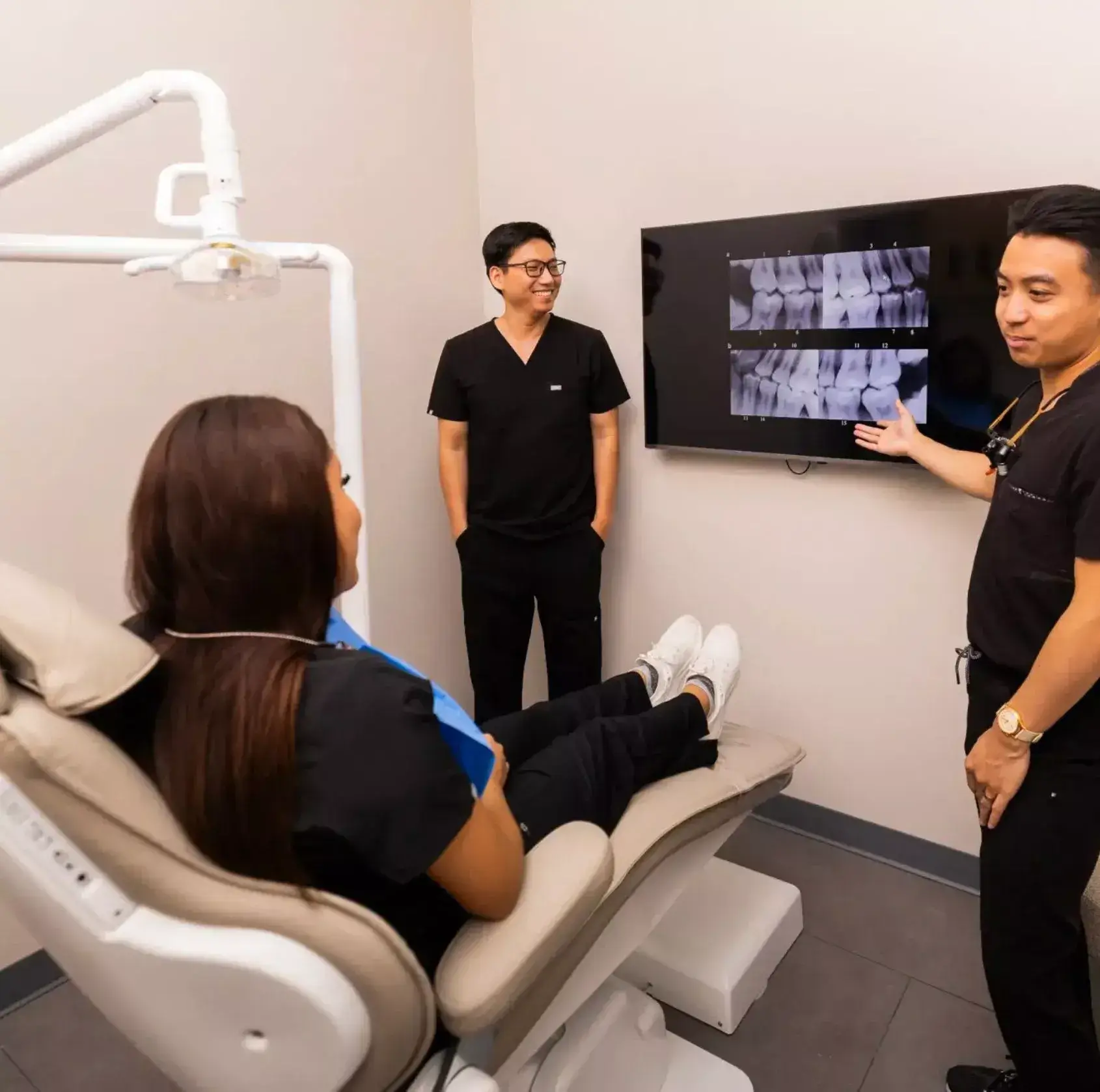
Low-radiation 3D imaging maps your existing bone — width, height, density, and proximity to nerves or sinus. Dr. Huynh shows you exactly where bone is missing and explains the type of graft that fits.
You’ll get a written estimate, sedation options, and pre-op instructions before scheduling.
STEP 2 · DURING
Graft Placement
Local anesthesia numbs the area completely — you feel pressure, not pain. Biocompatible graft material is placed exactly where the bone needs to rebuild, then secured under a protective membrane.
IV sedation is available throughout — most patients describe sedation grafts as feeling like a brief, comfortable nap.
STEP 3 · AFTER
Healing & Bone Regeneration
Soreness lasts 2–3 days, similar to a tooth extraction. Soft foods for a week, no smoking, and no straws (same dry-socket risk).
Over 4–6 months, your body integrates the graft and rebuilds bone. Once imaging confirms density, the implant phase begins.
Why Trust Aster Smiles for Dental Bone Grafting
Bone grafting is real surgery. The biology works, but the surgical execution and the dentist who plans both the graft AND the eventual implant matter enormously. Here’s the credential and protocol stack behind every dental bone grafting case at Aster Smiles:
For anxious patients or longer grafting cases, we also perform the procedure under in-office IV sedation at a flat fee instead of the per-minute billing other Cypress practices pass through from contracted anesthesiology.
- Dr. Thanh Huynh, DMD, FAGD — fellowship distinction held by fewer than 7% of dentists
- Advanced training in oral surgery, bone grafting, and implant placement under one practitioner
- Low-radiation 3D imaging for every case — bone density, height, and width mapped before surgery
- FDA-cleared, biocompatible graft materials used at the appropriate type and volume for your case
- IV sedation under a TSBDE Level 3 (Moderate Parenteral Sedation) permit with continuous vital monitoring
- Sterile, hospital-grade infection control protocols throughout the surgical visit
The Bone Graft Recovery Timeline
FIRST 24–48 HOURS
Mild swelling, ice on the cheek, soft cold foods only. Take prescribed meds before pain hits. No straws, no smoking, no spitting forcefully (dry-socket risk).
WEEK 1
Most patients return to normal activity. Soft food diet continues. Gentle salt-water rinses after meals.
WEEKS 2–4
Soft tissue healing largely complete. Internal bone integration is just getting started. Diet expands gradually.
MONTHS 4–6
Bone fully integrates. Imaging confirms density. Implant placement scheduled.
CALL US RIGHT AWAY IF
Severe pain after day 3 · Fever or pus · Membrane visibly exposed · Bleeding that won’t stop with pressure.
How Much Does Dental Bone Grafting Cost in Cypress?
Cost depends on the type of graft, the size of the area, and which sedation level you choose. Socket preservation grafts are one tier. Ridge augmentation and sinus lifts are more involved. We give every patient a written estimate before the procedure is scheduled.
OPTION 1
With Insurance
Partial
Coverage varies
Insurance coverage for dental bone grafting varies by plan and reason. Socket preservation at extraction is more often covered than standalone ridge augmentation. We verify benefits before treatment so you know your out-of-pocket.
OPTION 2 · BEST VALUE
Wellness Plan Members
25% Off
$24/mo adult plan. 25% off dental bone grafting. IV sedation is priced the same for every patient. Often saves more on a single graft + implant case than several years of plan dues. See plan →
OPTION 3
Financing Available
0% APR
Through CareCredit & Cherry
Most patients combine bone graft + implant financing into one monthly payment plan — including 0% APR options for qualified applicants. We help you apply during your consultation.
Specific dollar amounts depend on the type of graft (socket preservation vs. ridge augmentation vs. sinus lift), the size of the area, and chosen sedation level. Every case starts with 3D imaging and a clear, written estimate before any surgery is scheduled.
Patients Who Trusted Us With Their Surgical Care
★★★★★
“Dr. Huynh was professional and took the time to explain everything clearly before the procedure, which really helped put me at ease. I felt well cared for and never rushed.”
— Don N., Cypress TX
★★★★★
“Dr. Huynh is a highly skilled and gentle dentist, so I rarely feel any pain during procedures. I always receive a clear explanation of costs before any procedure.”
— Tram N., Cypress TX
★★★★★
“The Dentist is patient and very thorough and the staff is so professional. They take their time to explain your treatment plan and cost. The technology is top notch.”
— Michaela B., Cypress TX
Dental Bone Grafting FAQs
Dental bone grafting is a procedure where biocompatible graft material is placed into an area of the jaw where bone has been lost or shrunk. Over the following months, your body integrates the material and generates new bone — rebuilding the density and volume needed to support dental implants or maintain facial structure. The materials used are FDA-cleared and well-established.
Not during. The area is fully numbed with local anesthesia, so you feel pressure but not pain. IV sedation is also available if you want to be deeply relaxed. After the procedure, soreness is typically similar to a tooth extraction — manageable with prescribed pain medication for 2–3 days. Most patients describe recovery as more comfortable than they expected.
4–6 months is typical for most cases — this is the time your body needs to integrate the graft material and rebuild solid, dense bone. Sinus lifts can take 6–9 months. Socket preservation grafts placed at the time of extraction often heal alongside normal extraction recovery. We monitor progress with imaging at follow-up appointments and confirm density before moving to the implant phase.
Not always. Some patients have plenty of bone for immediate implant placement. The need depends on how long the tooth has been missing, whether there’s been gum disease, and the specific anatomy of your jaw. We use 3D imaging to measure your existing bone and tell you honestly whether grafting is necessary, optional, or unnecessary. If a previous dentist said you need a graft and you want a second opinion before committing, bring your imaging — we’ll give you a candid read.
Cost depends on the type of graft (socket preservation, ridge augmentation, sinus lift), the size of the area, and the sedation level chosen. Insurance coverage varies — socket preservation at the time of an extraction is more often covered than standalone grafts. Wellness Plan members save 25% on most treatments. IV sedation is priced the same for every patient. Financing through CareCredit and Cherry is available, including 0% APR for qualified applicants. Every case gets a written estimate before scheduling.
Yes — and it’s often the smartest move. A socket preservation graft placed at the time of tooth extraction stops the bone loss that would otherwise begin within weeks. Without it, you can lose about 25% of the ridge width in the first 12 months. With it, you keep the site implant-ready. One appointment, two procedures, one recovery.
There are several options, all FDA-cleared and biocompatible. The most common in modern practice is processed donor bone (allograft) or synthetic bone substitute material — both safe, well-studied, and effective. Less commonly, bone is harvested from another site in your own mouth (autograft) when a specific case calls for it. Dr. Huynh will explain which material is right for your case and why during the consultation.
Depends on what comes next. If you’re getting an implant and there’s not enough bone, the implant simply can’t be placed reliably — failure rates climb sharply when there’s insufficient bone support. If you’re not pursuing an implant, the bone will continue to resorb gradually over years, contributing to facial structure changes (a sunken appearance), shifting of neighboring teeth, and a narrowing of treatment options later. Bone grafting isn’t always urgent, but the longer you wait, the more grafting is required to rebuild what was lost.
Been Told You Don't Have Enough Bone? Implants Aren't Off the Table.
Dental bone grafting can rebuild what’s been lost — and the same dentist who plans your graft will eventually place your implant. One office, one plan, no specialist hand-offs. At our Cypress dental office on FM 529.