Quick Answer: Clear Aligners vs. Braces comes down to your case complexity, your discipline, and your lifestyle. Clear aligners (like Invisalign) are nearly invisible, removable, and great for mild-to-moderate crowding, spacing, and bite issues — but they require wearing them 22 hours a day, every day, to work. Traditional braces are more visible but work 24/7 without your effort, handle complex rotations and severe bite corrections more reliably, and are often the better choice for teens or anyone who’d struggle with the compliance aligners require. Both cost roughly the same and take 12–24 months in most cases. The right choice in the Clear Aligners vs. Braces decision depends on your specific teeth, not on which one is “better.”
You’ve been thinking about it for a while now. Maybe years. That one tooth that sits a little crooked. The small gap that bothers you in every photo. The bite that your dentist has mentioned twice but you’ve never acted on.
Now you’re finally serious about it, and you’re stuck on the same question everyone gets stuck on: Clear Aligners vs. Braces — which one?
Here’s the honest answer most articles don’t give you: there isn’t a universal winner in Clear Aligners vs. Braces. Aligners aren’t always better because they’re newer and less visible. Braces aren’t always better because they’re “tried and true.” The right choice depends on how crooked your teeth actually are, how disciplined you are with a daily routine, whether you care about visibility, and sometimes things you haven’t even thought about yet — like whether you grind your teeth or play a wind instrument.
This guide walks through what actually matters in the Clear Aligners vs. Braces decision, from the dentist’s perspective, with no upselling. We offer both treatments at Aster Smiles, and patients leave our consultations with either recommendation depending on their case.
How Clear Aligners vs. Braces Actually Work
Both systems have the same goal — move teeth into better positions — but they do it with different mechanics, and the mechanics matter for which cases they handle best.
Traditional Braces
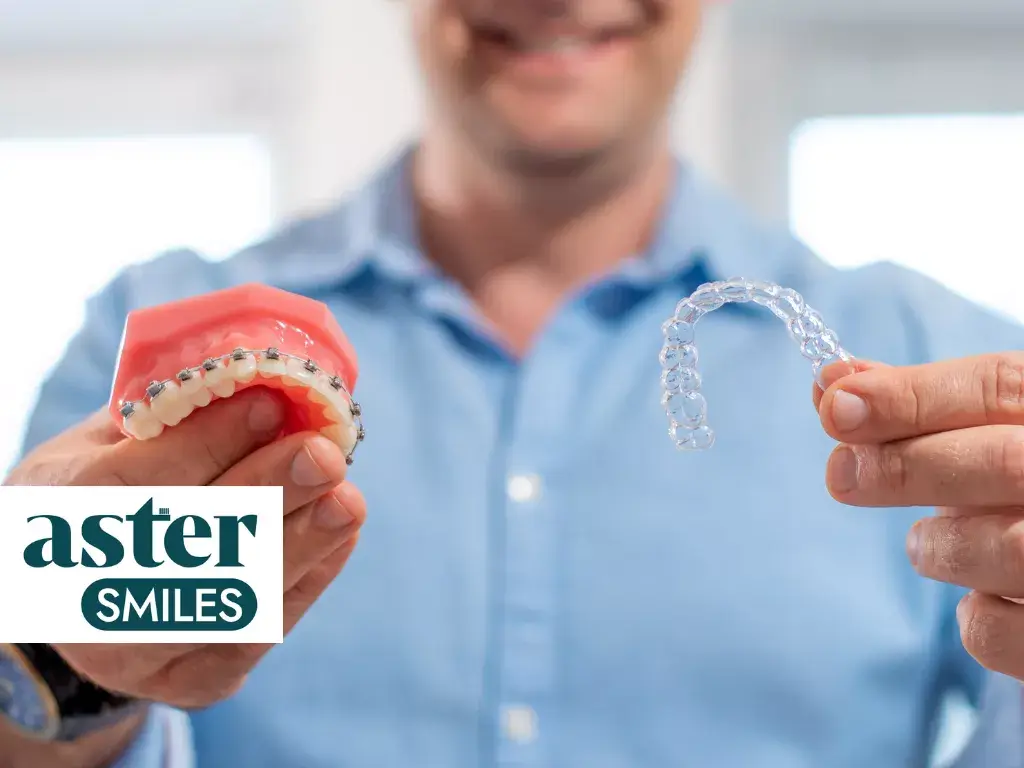
Small brackets are bonded directly to each tooth. A thin archwire runs through all the brackets, held in place by tiny elastic bands or clips. The wire wants to return to its original curved shape, so it applies a constant, gentle pull on each tooth. Every 4–8 weeks, we swap the wire for a slightly stronger one, progressively guiding teeth into place.
Key mechanical advantage: Because the bracket is physically glued to the tooth, braces can produce very precise three-dimensional movements — especially rotations and vertical movements — that are harder to achieve with aligners.
Clear Aligners (Invisalign and Similar Systems)
A series of custom clear plastic trays. Each tray is slightly different from the last, designed to move specific teeth about 0.25mm per tray. You wear one tray for 1–2 weeks, then swap to the next. Over the full treatment, you might go through 20–50 trays total.
Key mechanical advantage: The force is distributed broadly across many teeth at once, which is comfortable and effective for straightforward alignment issues. And because you remove them to eat and brush, hygiene is dramatically easier than with braces.
Both systems are built around the same biological principle: gentle, sustained pressure causes bone around the tooth to remodel, allowing the tooth to migrate into the desired position. Teeth don’t move in days — they move in weeks and months.
Clear Aligners vs. Braces: The Cases Each One Handles Best
This is where most comparison articles are vague, but it’s the most important section. The Clear Aligners vs. Braces choice isn’t really about preference — it’s about what your teeth need.
Cases where clear aligners work well:
- Mild-to-moderate crowding or spacing — teeth that are crooked or have small gaps, but not severely rotated or displaced
- Mild bite issues — small overbites, underbites, or crossbites
- Post-orthodontic relapse — teeth that were once straight and have shifted back over the years
- Patients who can reliably wear them 22 hours a day — this is non-negotiable for the treatment to work
Cases where traditional braces are usually the better call:
- Severe crowding or rotation — especially teeth rotated more than about 20 degrees
- Complex bite problems — significant overbite, underbite, open bite, or crossbite
- Vertical movement needed — pulling teeth up or pushing them down (hard with aligners)
- Growing patients (teens) — braces work predictably without the compliance challenge
- Impacted canines or teeth that haven’t erupted fully
- Patients who know they won’t stick to the 22-hour rule — even adults
Cases where it’s truly a preference call (either works):
- Mild-to-moderate cases with a disciplined patient — both options will produce excellent results
- Adults with minor relapse after childhood braces — often a short aligner course works beautifully
The honest truth is that about 70% of orthodontic cases can be treated successfully with either system. The other 30% are specifically suited to one or the other — and that’s where an in-person exam matters. We’ve seen patients come in set on aligners because they don’t want braces, only to discover their bite issue realistically requires braces for a predictable outcome. The opposite happens too.
Clear Aligners vs. Braces: Lifestyle Impact
This is where the decision gets personal. Two people with identical teeth might choose differently in the Clear Aligners vs. Braces conversation based on their daily life.
Visibility
Aligners: Nearly invisible at conversational distance. Most people won’t notice unless they’re very close. Some slight “glisten” may be visible in direct light.
Braces: Clearly visible, especially metal. Ceramic (tooth-colored) brackets are less obvious but still noticeable up close.
If you’re in front of clients, on camera, or about to get married — visibility may matter. If you’re in an environment where nobody’s looking that closely, it’s less of a factor.
Daily Life with Each Option
Eating:
- Aligners: No restrictions. Take them out, eat whatever you want, brush, put them back.
- Braces: Avoid hard, crunchy, sticky, and chewy foods. No popcorn, nuts, caramel, hard candy, ice, gum, or anything that could break a bracket. This is genuinely limiting for 18+ months.
Brushing and flossing:
- Aligners: Remove them, brush and floss normally, clean the aligners, put them back.
- Braces: Requires floss threaders or a water flosser to get under the wire. Many patients find this tedious and hygiene suffers — which can lead to white spots on teeth when the braces come off.
Appointments:
- Aligners: Check-ins every 6–10 weeks. Quick visits.
- Braces: Adjustments every 4–8 weeks. Slightly longer visits for wire changes.
Compliance Required
This is the big one in any Clear Aligners vs. Braces conversation. Braces work whether you think about them or not. Aligners only work if you actually wear them.
The official guidance is 22 hours per day. That sounds reasonable until you realize it means two hours total for eating and brushing — breakfast, lunch, dinner, snacks, and all hygiene combined. If you’re a three-meals-plus-snacks person, you’re already at your limit.
Patients who can’t realistically commit to this often get poor results with aligners — teeth don’t track correctly, treatment extends by months, and the final result is compromised. If you suspect you’re a “I’ll take them out for this wedding and this dinner and this long meeting” person, braces may actually be the more honest choice for your outcome.
Discomfort
Both cause some discomfort, especially in the first few days and after each adjustment or new tray. Braces can cause cheek and lip irritation until you get used to them — we provide wax to smooth over any rough edges. Aligners don’t have sharp parts but feel tight when you switch to a new tray.
On average, most patients rate discomfort as similar between the two. Ibuprofen handles the worst of it for the first 24–48 hours of each new phase.
Clear Aligners vs. Braces: Cost and Timeline
Cost
At Aster Smiles, Clear Aligners vs. Braces pricing is typically similar — usually within a few hundred dollars of each other for comparable cases. For context, orthodontic treatment in our area generally ranges from about $4,000 to $7,500 depending on complexity, with most straightforward adult cases falling in the middle of that range.
Insurance coverage varies:
- Many dental plans cover a portion of orthodontic treatment (often 50% up to a lifetime orthodontic maximum, commonly $1,500–$2,500)
- HSA and FSA funds can typically be used
- We offer in-house payment plans that spread the cost across the duration of treatment — no interest, no credit check
- If you don’t have insurance, our Wellness Plan discounts most treatments 20%, which applies to orthodontic care too
Timeline
- Simple cases (mild crowding or spacing): 6–12 months for either
- Moderate cases: 12–18 months
- Complex cases: 18–30 months — braces often finish faster than aligners for truly complex cases
Retainers after: Both treatments require retainers for the rest of your life. Teeth slowly want to return to their original positions, and retainers prevent that. We provide clear retainers after aligner treatment at our Cypress office. Some patients wear them full-time for the first year, then only at night indefinitely.
Clear Aligners vs. Braces for Teens
This is worth calling out because the answer is more nuanced than most parents expect.
Aligners can work for teens — there are specific teen aligner systems with compliance indicators (small blue dots that fade when the tray is worn enough). But candidly, they require a level of daily responsibility that many teens struggle with. If your teen already loses water bottles and retainers, aligners may be a hard fit.
Braces are often the safer bet for teens because they work regardless of the teen’s commitment to their schedule. Most adolescent orthodontic patients still get braces for this reason. It’s not a judgment of your kid — it’s just that the stakes of non-compliance are higher when teeth are still growing into their adult positions.
For teens with high discipline and mild-to-moderate cases, aligners can absolutely work. We evaluate this during the consultation.
What a Consultation at Aster Smiles Looks Like
- A digital scan of your teeth (no goopy impressions) to create a 3D model
- Full exam to check for any existing issues — cavities, gum disease, wear patterns — that need to be addressed before or during orthodontic treatment
- Discussion of your goals — what bothers you, what you want to fix, what timeline works for your life
- Honest recommendation on Clear Aligners vs. Braces for your specific case, including what each would realistically look like
- Written treatment plan with timeline, cost, and payment options
- No pressure to decide that day — we provide the plan, you take your time
Dr. Huynh offers both clear aligners in Cypress and traditional braces in-house, which means you don’t have to juggle multiple offices or get bounced between specialists. If orthodontic treatment surfaces something more complex that warrants a specialist, we’ll refer — but most cases can be handled start to finish with us.
Medically reviewed by Dr. Thanh Huynh, DMD, FAGD — Fellow of the Academy of General Dentistry, a credential held by fewer than 7% of general dentists. Last reviewed April 23, 2026.
Frequently Asked Questions About Clear Aligners vs. Braces
Which works faster — Clear Aligners vs. Braces?
Depends on the case. For simple cases, timelines are similar (6–12 months). For complex cases with significant rotations or bite corrections, braces often finish faster and more predictably. The “aligners are faster” claim you see in marketing is usually comparing best-case aligner timelines to worst-case brace timelines — which isn’t a fair comparison.
Can I switch from braces to aligners mid-treatment (or vice versa)?
Sometimes, yes — but it adds complexity and cost. If you’re early in treatment and your situation has changed (life event, budget shift), we can discuss whether a switch makes sense. It’s usually better to commit to one system from the start based on a realistic assessment.
Will my insurance cover Clear Aligners vs. Braces differently?
Most plans cover both at the same rate (typically a percentage, up to a lifetime orthodontic maximum). A few older plans still have language that specifically excludes aligners, though this is becoming rare. We check your benefits during the consultation so you know the out-of-pocket number before you commit.
Do aligners really work, or is it just marketing?
They work — for the right cases, with a compliant patient. Aligners are supported by decades of peer-reviewed research and FDA-approved for broad use. The skepticism that sometimes surrounds them usually stems from bad outcomes from direct-to-consumer aligner companies (mail-order systems with no in-person exam). Those are legitimately concerning. Clinic-supervised aligners like Invisalign, SureSmile, or ClearCorrect, used with proper diagnostics and oversight, produce excellent results.
Can I whiten my teeth during treatment?
With aligners, yes — the trays hold whitening gel against your teeth very effectively, so many patients combine treatments. With braces, no — the brackets block whitening agent from reaching the tooth surface underneath, so whitening has to happen after the braces come off.
What if my teeth shift back after treatment?
This is the single most preventable problem in orthodontics, and the answer is simple: wear your retainer. Teeth always want to return toward their original positions. Retainers prevent that drift. Most orthodontic relapse we see is from patients who stopped wearing their retainer after a year or two. We provide retainers as part of treatment and explain exactly how to use them.
I had braces as a teen and my teeth have shifted. Do I need full Clear Aligners vs. Braces treatment again?
Often no — many adult relapse cases can be corrected with a short aligner course (6–9 months) rather than full orthodontic treatment. Come in for a consultation and we’ll map out what your specific case needs.
Is it true aligners hurt less than braces?
Roughly equivalent, in our experience. Both cause soreness when pressure is first applied — the first week of braces and the first 1–2 days of each new aligner tray. The discomfort profile is different (braces can rub the cheeks; aligners feel tight all over), but the intensity is similar.
Ready to Make the Clear Aligners vs. Braces Decision?
Whether you’ve been thinking about this for months or years, the next step is straightforward: a consultation, a digital scan, and an honest conversation about what your specific case actually needs. No pressure to decide that day. You leave with a plan, a timeline, and a clear number.
Book Your Comfort-First Visit or call (832) 476-7676. Mention it’s an orthodontic consultation when you book so we can allow the right amount of time.
This article provides general information and is not personalized orthodontic advice. Every case is different — for a specific recommendation on Clear Aligners vs. Braces for your smile, please schedule a consultation.
Related reading: Learn more about our dental checkups and cleanings in Cypress (recommended before or during orthodontic treatment), and our Wellness Plan for discounted rates on treatment if you don’t have insurance.