Type “best sedation dentist near me” into Google from anywhere in Cypress and every result says roughly the same thing: gentle, caring, comfortable. None of those words are checkable. If you’re the person who has been putting the dentist off — not for months, but years — you don’t need another practice telling you it’s gentle. You need a way to tell, before you’re in the chair, whether an office can actually sedate you, safely, at a price it will say out loud.
That is a checkable question, and this post is the checklist. It comes from Dr. Thanh Huynh, DMD, FAGD, who administers IV sedation himself at Aster Smiles in Cypress, TX under his own TSBDE Level 3 sedation permit — so the questions below are the ones he’d want a family member to ask, of any office, including this one.
Start here: “sedation dentistry” doesn’t mean one thing
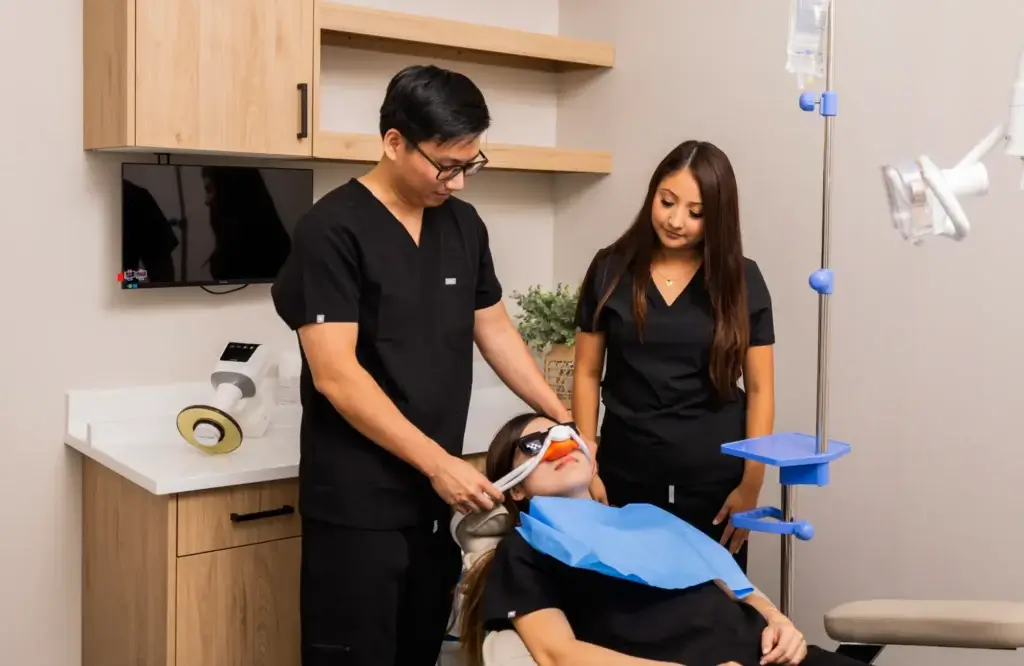
When a website says “sedation available,” it can mean anything from a calming TV on the ceiling to full IV sedation dentistry. At Aster Smiles it means two specific options: nitrous oxide — laughing gas, mild, wears off in minutes, usually available same-day — and IV moderate sedation, where most patients report remembering little to nothing about the procedure afterward.
The gap between those two is enormous, in effect, in regulation, and in what the office has to be equipped to do. That gap is exactly where the marketing hides. If you’re still deciding which level you even want, how nitrous and IV sedation compare covers that decision on its own. The rest of this post assumes the harder problem: you know you need real sedation, and you’re trying to pick the office.
The 7 questions that sort a real sedation dentist from a marketing line
1. Who actually administers the sedation?
At some offices the dentist sedates you personally. At others, a visiting anesthesiologist or CRNA comes in on certain days, on their schedule, at their rates. Neither is wrong — but they are different appointments, different bills, and different waits. Ask the question directly: “Who starts the IV, and who watches me during treatment?” At Aster Smiles the answer is Dr. Huynh, in-office, with the Aster team monitoring throughout — there is no outside provider to schedule around.
2. What permit do they hold — and can you verify it?
Texas regulates dental sedation by permit level through the Texas State Board of Dental Examiners. IV moderate sedation requires a Level 3 (Moderate Parenteral) permit — nitrous alone requires much less. Most general dentists in Cypress do not hold a Level 3 permit, which is why so many offices advertise “sedation” but quietly mean nitrous. You can verify any Texas dentist’s sedation permit on the TSBDE’s public license search before you ever call. Dr. Huynh holds Level 3.
3. Is the sedation fee flat, or billed by the clock?
When sedation is contracted out, it is typically billed by time — and a procedure that runs long costs more, which gets passed to you. A flat fee means the number cannot move. At Aster Smiles IV sedation is $500 for up to an hour, $800 for one to two hours, and $1,000 flat beyond two hours — the same for every patient, quoted together with the treatment cost before anything starts. However an office structures it, the test is the same: do you know the full number before you’re sedated?
4. How will you be monitored?
Moderate IV sedation is very safe in qualified hands, and the monitoring is a large part of why. Ask what gets tracked. The answer you want to hear: heart rate, blood pressure, and oxygen levels, continuously, for the whole visit — which is what we run at Aster Smiles on hospital-grade equipment. An office that can’t answer this question quickly is telling you something.
5. What happens when the numbing shot doesn’t work?
If you’ve ever had four rounds of anesthetic and still felt the drill — and been told it was “just nerves” — you were not imagining it. Acutely inflamed teeth genuinely are harder to numb. A practice that calls itself pain-free but has no answer beyond “more lidocaine” hasn’t solved the problem you actually have. The honest answer involves supplemental injection techniques plus sedation, so you’re not white-knuckling the chair while the anesthesia problem gets worked. This is the single most common reason patients who’ve “tried the gentle dentist before” end up here.
6. Can they do the actual dentistry in the same chair?
Sedation is a means, not the treatment. If the office sedates you but refers out the extraction, the implant, or the surgical work, you’re back to multiple offices and multiple anesthesia bills. Extractions, wisdom teeth, and dental implant placement are done in-house at Aster Smiles, under the same in-house sedation — one office, one plan, one combined quote. And when a case genuinely belongs with a specialist, we say so before you’re sedated, not after.
7. Do the logistics actually work for your life?
Two practical things decide whether sedation dentistry happens or stays a browser tab. First, hours: we’re open Saturdays 9 to 4, which is when most people who’ve been putting this off can actually come. Second, timing: IV sedation is never a same-day appointment — it requires fasting beforehand and a driver home, so it gets scheduled ahead. Nitrous, on the other hand, usually is available same-day. Any office that offers to run an IV sedation case on a walk-in basis is answering question 2 for you.
What this looks like from our Cypress office
One of our patients drives in from Jersey Village — about 15 minutes straight west on 290. He hadn’t seen a dentist in over a decade, and what finally moved him wasn’t pain; it was getting these exact questions answered on the phone before booking. First visit was a Saturday morning: exam, X-rays, no lecture, and a written plan with the sedation fee and treatment cost on one page. He did the work over two IV sedation visits, his wife drove him home each time, and his line afterward was the one we hear most: “I remember the IV going in, and then you were done.”
Paying for it: insurance, financing, and the Wellness Plan
We accept most major PPO plans, and the sedation fee is quoted alongside the treatment cost so the total is on the table before you decide anything. No insurance? The Aster Wellness Plan runs $24/month for adults and $21/month for kids and covers your exams and X-rays — and financing through Cherry and CareCredit can spread the rest into monthly payments. Details are on the insurance and financing page. The short version: the money conversation happens before treatment, in writing, or not at all.
Why anxious patients across Cypress end up at Aster Smiles
Not because the website says gentle — every website says gentle. It’s because the seven questions above all have verifiable answers here: Level 3 permit held by the dentist himself, sedation administered and monitored in-house, flat fees said out loud before treatment, and the dentistry done in the same chair. That’s also why a share of our sedation cases arrive as referrals from other Cypress offices.
If it’s been six months or six years, the first appointment is the same: you talk, we listen, and nothing happens until you’ve seen the plan and the numbers. Read more about IV sedation at Aster Smiles, or bring us your hardest question first — that’s what it’s for.
Common questions about choosing a sedation dentist
How do I find the best sedation dentist near me?
Skip the adjectives on the website and check three verifiable things: who holds the sedation permit (in Texas you can look a dentist up on the TSBDE license search), who actually administers the sedation on the day, and how the fee is quoted. A dentist who holds the permit personally, sedates you in their own office, and quotes a flat figure before treatment has answered the question better than any “best of” badge can.
What is the difference between a pain-free dentist and a sedation dentist?
“Pain-free dentist” is a marketing phrase — any office can print it, and no dentistry is guaranteed painless. “Sedation dentist” points to something regulated: administering IV sedation in Texas requires a specific TSBDE permit, training, and monitoring equipment. If a genuinely comfortable visit is what you are after, ask about the permit and the monitoring rather than the slogan.
Does seeing a sedation dentist cost more?
The dentistry itself costs the same — sedation is a separate fee on top. At Aster Smiles the IV sedation fee is flat: $500 for up to an hour, $800 for one to two hours, and $1,000 beyond two hours, the same for every patient, with the combined number quoted before treatment begins. Offices that bill sedation by the fifteen minutes cannot tell you the final figure until it is over.
Can I get sedation the same day I call?
Nitrous oxide, usually yes — it needs no fasting and no driver, and it wears off within minutes of the mask coming off. IV sedation is always a scheduled visit, because it requires fasting beforehand, a short pre-sedation medical review, and a responsible adult to drive you home. If you are in pain today, we treat the pain today and schedule the IV sedation visit separately.
Do you see sedation patients from outside Cypress, like Jersey Village or Bridgeland?
Yes — a large share of our sedation patients drive in from the surrounding communities, including Jersey Village, Bridgeland, Towne Lake, Fairfield, and Copperfield. The office is at 20611 FM 529, Suite 109 in Cypress, roughly 5 to 20 minutes from most of those neighborhoods, and we are open Saturdays from 9 to 4.
Is IV sedation at a general dentist safe?
In qualified hands, yes — and “qualified” is checkable, not a feeling. In Texas that means a TSBDE Level 3 Moderate Parenteral Sedation permit, a pre-sedation medical review, and continuous monitoring of your heart rate, blood pressure, and oxygen levels throughout the visit. IV sedation is not right for everyone — certain medical conditions need physician clearance first, which is exactly what the screening is for.
Ready to ask us the seven questions? Call (832) 476-7676 — you’ll get the permit, the monitoring, and the flat fee answered on the phone, no visit required. Or book online and put “sedation consult” in the notes. Saturday appointments available, 9 to 4.
Last Reviewed By: Dr. Thanh Huynh, DMD, FAGD — August 2026